Normalize time
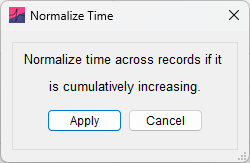
The time in electrophysiological data may be recorded in two ways. If ‘normalized’, the times of each record are the absolute record length (e.g. for \(2\ \mathrm{s}\) recordings, record 1: \(0\)–\(2\ \mathrm{s}\), record 2: \(0\)–\(2\ \mathrm{s}\)).
Alternatively, time may be recorded relative to the start of recording, increasing cumulatively (e.g. record 1: \(0\)–\(2\ \mathrm{s}\), record 2: \(2\)–\(4\ \mathrm{s}\)).
In the case that times are cumulative, Normalize Time normalises them. This is done by replacing the time values for every record with those from the first record, maintaining the time offset if not corrected on load.